How product-level data can support Scope 3 reporting
Cleaning and hygiene supplies purchased by an organisation may contribute to Scope 3 Category 1: Purchased Goods and Services under the GHG Protocol Corporate Value Chain Standard.
The GHG Protocol recognises four methods for calculating Category 1 emissions. The supplier-specific method — which uses product-level cradle-to-gate data provided directly by the supplier — is described as the most accurate approach when robust data is available, because it relates to the specific product purchased rather than an industry average.
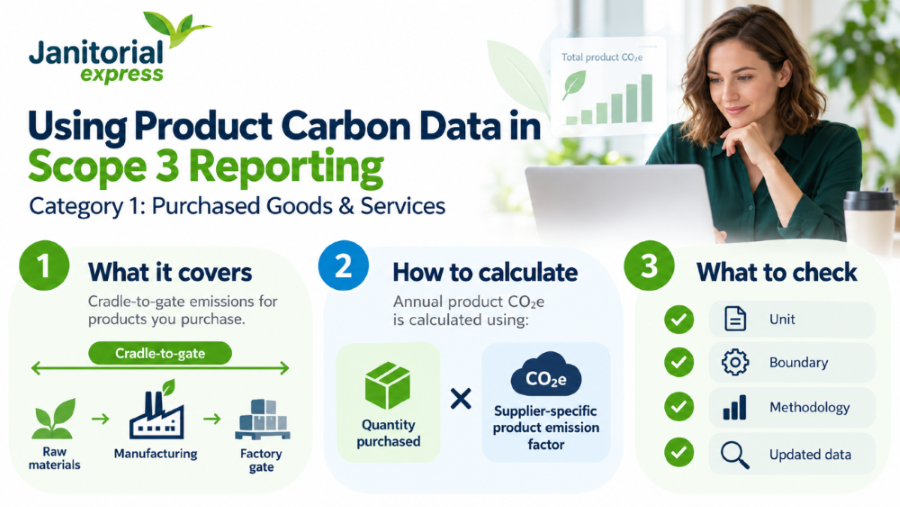
The calculation is straightforward:
Annual product CO2e = quantity purchased × supplier-specific product emission factor
For example, if a product has a declared emission factor of 0.8 kg CO2e per case and you purchase 500 cases in a year, the estimated contribution to Category 1 would be 400 kg CO2e for that product line.
Organisations remain responsible for deciding how supplier data is used within their own reporting. You should follow your organisation's reporting policy, the GHG Protocol guidance for your sector, and the advice of your sustainability or finance team.
Questions to ask before using a supplier's carbon figure
Before incorporating a product carbon figure into procurement decisions or internal reporting, work through this checklist:
- What is the functional unit — kg CO2e per case, roll, litre, kilogram or other measure?
- Which life-cycle stages are included and which are excluded?
- Which standard or LCA methodology was used — for example ISO 14067 or the GHG Protocol Product Standard?
- Is the result based on actual operational data, modelled estimates or industry averages?
- Has the methodology been independently reviewed or verified by a third party?
- When was the calculation last updated, and does it reflect current production?
- Does the figure relate to the exact product code and pack size being purchased?
- Are transport to the buyer, use-phase impacts and end-of-life treatment included or excluded?
A supplier that can answer all eight questions clearly is providing data that is more likely to be usable in reporting.
Product carbon data for Katrin hygiene products
Metsä Tissue, the manufacturer of Katrin tissue and hygiene products, provides product-level CO2 calculations across its Katrin range through its Metsä CO2 Service.
The following facts are based on published information from Metsä Tissue:
- Product-level CO2 calculations are available for Katrin tissue products, dispensers and hygiene solutions
- Metsä Tissue states that calculations are based on actual operational production data rather than industry averages
- The LCA methodology is aligned to ISO 14040, ISO 14044 and ISO 14067
- The methodology has been independently reviewed by RISE Research Institutes of Sweden
- CO2 data is available on individual product pages and product data cards on the Katrin website
- The calculations are described as cradle-to-gate figures
Customers should consult the individual product page or product data card for the relevant figure, declared unit, boundary, assumptions and the most recent available data for the specific product and pack size being purchased.
No comparative environmental claims are made here about Katrin products versus other brands. Carbon figures should be assessed on a like-for-like basis using the checklist above.
How Janitorial Express can help
Janitorial Express supplies cleaning, washroom and hygiene products to commercial customers across the UK. We can help you:
- Identify which products in our range have available product-level carbon documentation
- Understand what a CO2e figure covers for a specific product
- Compare pack sizes and product units on a like-for-like basis
- Build a product list that supports internal purchasing reviews or sustainability reporting discussions
We do not provide formal carbon accounting or sustainability consultancy. For reporting decisions, we recommend working with your sustainability adviser or finance team alongside the product data we can supply.
Need help interpreting carbon data for your hygiene and cleaning supplies?
Contact Janitorial Express to discuss available product information and suitable options for your site.
You may also find these pages useful:
- Request a commercial quote
- Sustainability guide for commercial buyers
- Browse Katrin products
- Business resources and guides
Frequently asked questions
Is cradle-to-gate the same as a full product life-cycle carbon footprint?
No. A full life-cycle assessment covers all stages from raw material extraction through to end-of-life treatment, including use-phase impacts. Cradle-to-gate covers only the stages up to the point the product leaves the manufacturer's facility. Delivery, use and disposal are not included unless the manufacturer states otherwise.
Can I use a supplier's product carbon figure for Scope 3 reporting?
Supplier-specific product-level cradle-to-gate data can be used as an emission factor in Scope 3 Category 1 calculations under the GHG Protocol supplier-specific method. You should confirm that the data is robust, verify the declared unit and boundary, and follow your organisation's reporting policy before using any figure in a formal submission.
Can I compare CO2e figures from different cleaning product suppliers?
Only where the functional unit, life-cycle boundary, methodology and data year are equivalent. Figures calculated using different methods, boundaries or units should not be compared directly without adjustment. If in doubt, ask both suppliers to confirm their methodology before drawing conclusions.
What does CO2e mean?
CO2e stands for carbon dioxide equivalent. It is a standard unit used to express the global warming impact of different greenhouse gases on a single comparable scale. Gases such as methane and nitrous oxide are converted into their CO2 equivalent based on their global warming potential over a 100-year period.
Is the product with the lowest CO2e figure always the best choice?
Not necessarily. A lower CO2e figure per unit does not automatically mean lower total emissions if the product requires more units per task, more frequent replacement or higher energy or water use during application. Total impact depends on the full system of use, not just the manufacturing footprint.
Where can I find carbon footprint information for Katrin products?
Metsä Tissue publishes product-level CO2 data through its Metsä CO2 Service. Data is available on individual product pages and product data cards on the Katrin website at metsagroup.com/katrin. Janitorial Express can also help you locate documentation for specific products in our range — contact us here.
Sources and further reading
- GHG Protocol — Technical Guidance for Calculating Scope 3 Emissions, Category 1: Purchased Goods and Services:
ghgprotocol.org
- Metsä CO2 Service — product-level carbon data for Katrin products:
metsagroup.com/katrin/sustainability/metsa-co2-service
- ISO 14067 — Greenhouse gases: Carbon footprint of products:
iso.org