Sustainable Cleaning Procurement: A Practical Guide for UK Facilities Teams
Sustainability has moved from a nice-to-have to a hard procurement requirement. Surveys now show that 60% of UK businesses factor sustainability into their choice of cleaning provider, and 87% of cleaning professionals across the UK rate it as important to the sector's future. For facilities managers, cleaning contractors, and procurement teams, that shift creates a clear business case: green credentials win contracts.
This guide helps UK procurement teams, facilities managers, and cleaning contractors specify sustainable cleaning supplies, assess suppliers, and evidence environmental performance in tenders and ESG reporting.
The challenge is that sustainability still needs to stack up financially. With cleaning costs forecast to rise 23% between 2025 and 2030, any environmental improvement that also reduces waste, chemical use, or energy consumption pays for itself twice over.
The good news: the most impactful sustainability changes in a cleaning operation are also some of the most cost-effective. This guide covers the six key areas where you can make a measurable difference, without compromising hygiene standards or blowing your budget.
Key takeaways
-
Switch to certified eco-friendly chemicals with proper dilution controls
-
Microfibre technology can cut water use by up to 70% and chemical use by up to 90%
-
Concentrated products and refillable dispensers reduce plastic waste significantly
-
Staff training is the single biggest lever for consistent, sustainable outcomes
-
Sustainable procurement is now an ESG expectation, not just a preference
-
Suppliers must be able to evidence their sustainability credentials, not just claim them
1. Switch to Certified Eco-Friendly Cleaning Chemicals
The starting point for any sustainable cleaning programme is the product list. Conventional cleaning chemicals often contain volatile organic compounds (VOCs), phosphates, and synthetic fragrances that are harmful to aquatic environments and indoor air quality. Replacing them with certified alternatives is the most visible and verifiable sustainability step you can take, and the one most likely to be scrutinised in a tender or ESG audit.
What to look for in sustainable cleaning products
When reviewing your chemical range, prioritise products carrying recognised third-party certifications. These confirm that environmental claims have been independently verified, not just self-reported by the manufacturer.
|
Certification |
What it means |
|---|---|
|
EU Ecolabel |
Independently verified low environmental impact across the product lifecycle |
|
Cradle to Cradle |
Assesses safety, circularity, and responsible manufacturing |
|
Leaping Bunny / Cruelty Free |
No animal testing at any stage of production |
|
Biodegradable formulas |
Active ingredients break down safely without persisting in waterways |
If your current supplier cannot provide certified alternatives across your core product categories, that is a procurement conversation worth having. Certification availability is a basic indicator of whether a supplier takes sustainability seriously or treats it as a marketing claim.
Janitorial Express stocks a range of eco-certified cleaning products, including EU Ecolabel and Cradle to Cradle certified lines, alongside environmental concentrates designed to reduce packaging waste and chemical use across your operation.
The COSHH angle
Switching to lower-hazard products is not just an environmental decision. Under COSHH regulations, employers are required to reduce exposure to hazardous substances as far as reasonably practicable. Eco-certified products with lower VOC content and reduced hazard classifications can simplify your COSHH assessments and reduce the risk of staff health issues linked to chemical exposure.
Important: even products marketed as "eco-friendly" carry hazards. Always check the Safety Data Sheet (SDS) and ensure COSHH assessments are updated when you change products.
2. Adopt Microfibre Technology Across Your Operation
Microfibre is one of the highest-impact changes a cleaning team can make, and it costs less to run than the traditional mop-and-bucket approach. The science is straightforward: microfibre cloths and flat mop systems work through mechanical action, physically lifting and trapping dirt rather than relying on chemical solvents to dissolve it.
The performance data is compelling. According to the Sustainable Facilities Forum, microfibre systems cut water use by up to 70% and chemical use by up to 90% compared with traditional methods. That is not a marginal improvement; it is a fundamental shift in how much resource each clean requires.
For procurement teams: microfibre adoption is increasingly cited as evidence of operational sustainability in contract tenders. It is a measurable, verifiable change with documented resource savings.
How to implement microfibre effectively
The transition is straightforward but requires a structured approach to deliver the full benefit:
-
Audit current cleaning methods by area type (washrooms, hard floors, glass, kitchens) and identify where traditional cloths and string mops are still in use.
-
Replace like for like with colour-coded microfibre cloths and flat mop systems. Colour coding also supports COSHH compliance by preventing cross-contamination between zones.
-
Establish a laundering protocol. Microfibre must be washed at the correct temperature (typically 60°C) without fabric softener, which clogs the fibres and destroys their cleaning performance.
-
Train staff on technique. Microfibre works differently to cotton. Staff need to understand the correct pressure, motion, and folding technique to get full performance from each cloth.
-
Track usage and replacement cycles. High-quality microfibre cloths can withstand 200 to 500 wash cycles before performance degrades. Tracking replacement cycles avoids both premature disposal and the hygiene risk of using worn-out cloths.
Janitorial Express supplies a full range of colour-coded microfibre cloths and flat mop systems suited to commercial cleaning operations of all sizes.
Cost note: the upfront investment in microfibre is recovered quickly through reduced chemical spend and lower water consumption. For larger operations, the savings compound significantly over a 12-month period.
3. Use Concentrated Products and Dilution Control Systems
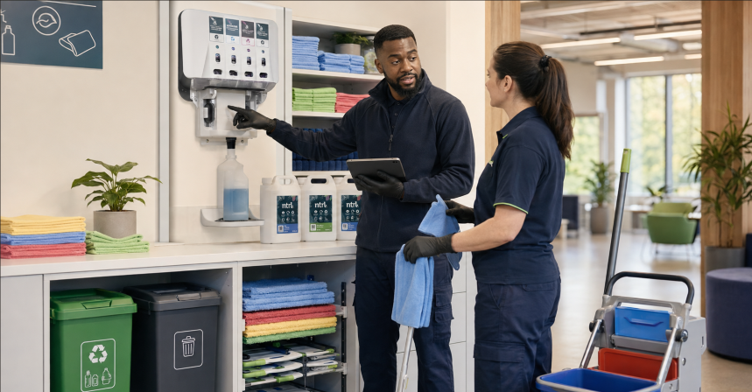
One of the most overlooked sustainability improvements in a cleaning operation is also one of the simplest: switching from ready-to-use (RTU) products to concentrated formulas used with accurate dosing systems.
The environmental logic is straightforward. RTU products are mostly water. You are paying to transport, store, and dispose of packaging that is 90 to 95% water. Concentrated products deliver the same active ingredient volume in a fraction of the space, with dramatically less plastic packaging per litre of working solution.
The case for dilution control
Accurate dilution control does more than reduce packaging waste. It solves a persistent operational problem: overuse. Without a dosing system, operatives routinely over-dilute or under-dilute products. Over-dilution wastes chemical and money; under-dilution means weaker cleaning performance and potential hygiene failures.
A properly specified dilution control system delivers:
-
Consistent product performance every time, regardless of which operative is using it
-
Measurable cost-in-use reduction compared with RTU products or manual dilution
-
Reduced packaging waste through refillable dispenser systems and concentrated bulk supply
-
A clear audit trail for sustainability reporting, showing actual chemical volumes used per site
The UK Cleaning Products Industry guidance on sustainable cleaning is explicit on this point: favour concentrated products where applicable and service dosing equipment regularly to maintain accuracy. A poorly calibrated dosing pump negates the environmental benefit entirely.
Practical tip: when reviewing your product range, ask your supplier for cost-in-use analysis comparing RTU versus concentrate. In most categories, concentrate wins on both cost and environmental impact once packaging and transport are factored in. Janitorial Express provides cost-in-use analysis as part of its trade account service.
4. Manage Waste as a Controlled System
Waste management in a cleaning operation is not just about recycling bins. It encompasses chemical disposal, packaging waste, consumable end-of-life, and the duty of care documentation that proves your waste is being handled lawfully.
The Better Buildings Partnership guidance on embedding sustainability in cleaning services frames it clearly: waste must be treated as a controlled system, not an afterthought. That means designing your waste flows, training staff to manage segregation correctly, and maintaining a complete audit trail.
Building a practical waste management system
Step 1: Audit your waste streams. Identify what types of waste your cleaning operation generates: chemical containers, disposable cloths, paper and plastic consumables, WEEE (waste electrical and electronic equipment from machinery), and general refuse. Each stream has different disposal requirements.
Step 2: Implement segregation at source. Provide clearly labelled bins for each waste stream in your cleaning cupboards and back-of-house areas. Staff cannot segregate correctly if the infrastructure is not in place.
Step 3: Maintain duty of care documentation. Under UK waste legislation, you are legally responsible for your waste until it reaches its final destination. Keep waste transfer notes, carrier licences, and disposal records. This documentation is increasingly required as evidence in ESG audits and contract renewals.
Step 4: Reduce before you sort. The waste hierarchy prioritises reduction over recycling. Switching to concentrated products, reusable microfibre, and refillable dispensers reduces the volume of waste generated in the first place, which is more effective than recycling it after the fact.
Step 5: Review consumable choices. Single-use paper roll, disposable cloths, and non-recyclable packaging all add to landfill. Where performance allows, switch to washable alternatives or products with recyclable packaging.
For ESG reporting: documented waste management processes, including segregation protocols and duty of care records, are among the most commonly requested evidence items in cleaning contract renewals and supplier audits. Having this system in place before a tender is a competitive advantage.
5. Invest in Staff Training
Every product switch, equipment upgrade, and process change in a cleaning operation is only as effective as the people delivering it. Sustainable cleaning that is not properly understood by operatives quickly reverts to old habits: over-dosing chemicals, incorrect microfibre technique, or waste going into the wrong bin.
Training is the multiplier that makes every other investment work. It is also increasingly required as documented evidence in ESG reporting and contract tenders.
What good sustainable cleaning training covers
Effective training for cleaning operatives should address the following areas:
-
Correct product use: how to dilute concentrates accurately, what each product is designed to clean, and what it should never be used on
-
Microfibre technique: the correct folding method, pressure, and motion to achieve a hygienic clean without relying on chemical action
-
Colour coding systems: why cross-contamination matters and how the colour-coded system prevents it
-
Waste segregation: which bin receives which waste, and why contamination undermines recycling
-
Energy and water awareness: switching off lights and HVAC systems when cleaning outside of core hours, not leaving taps running, and reporting leaks promptly
-
COSHH awareness: understanding the hazards of the products they use, even eco-certified ones, and knowing what to do in the event of a spill
The role of accredited training
Accredited training helps cleaning operatives develop the practical skills and knowledge needed to work safely, consistently, and sustainably. Janitorial Express provides access to accredited online training through the Jangro Learning Management System. The courses cover cleaning procedures, correct product use, equipment, health and safety, infection control, and environmental awareness.
For organisations tendering for contracts or reporting on ESG performance, a trained workforce with documented course completion provides valuable supporting evidence. It demonstrates that sustainable practices are understood by cleaning operatives and embedded in day-to-day operations, rather than existing only within a written policy.
Contact Janitorial Express to discuss access to Jangro LMS online training for your cleaning team.
6. Choose Suppliers Who Can Evidence Their Sustainability
The sustainability of your cleaning operation does not stop at your site boundary. It extends into your supply chain: the chemicals you buy, the equipment you specify, and the distributors you source from. Choosing the right supplier is one of the most leveraged procurement decisions you can make, because it shapes every product decision that follows.
This is also the area where the gap between marketing claims and verifiable evidence is widest. Any supplier can describe themselves as sustainable. Very few can prove it.
What to ask a cleaning supplies supplier
When evaluating a supplier's sustainability credentials, go beyond marketing claims and ask for documented evidence:
|
Question |
What to look for |
|---|---|
|
What certifications do your eco products carry? |
EU Ecolabel, Cradle to Cradle, or equivalent third-party verification |
|
Can you provide Safety Data Sheets for all products? |
Immediate availability, not "we'll send those over" |
|
Do you offer cost-in-use analysis for concentrates? |
Willingness to show the numbers, not just claim savings |
|
What is your packaging take-back or recycling policy? |
A concrete scheme, not a vague commitment |
|
Do you hold any environmental accreditations? |
ISO 14001, carbon neutral status, or sector-specific recognition |
|
Can you support staff training? |
Access to BICSc, Jangro LMS, or equivalent accredited programmes |
Why accreditation matters in the supply chain
Independently verified accreditations provide assurance that a supplier's environmental claims have been audited by a third party. The Neutral Carbon Zone (NCZ) Gold Accreditation, for example, is a recognised standard for carbon management in commercial organisations, requiring businesses to measure, reduce, and offset their carbon footprint to a verified standard.
Working with accredited suppliers also simplifies your own ESG reporting. When your supply chain can provide documented evidence of environmental performance, that evidence flows into your sustainability disclosures without requiring additional audit work on your part.
A tender-ready supplier checklist
Use this checklist when evaluating or renewing cleaning supply contracts. Each item represents a procurement requirement you can include in a tender specification or supplier review:
-
Eco-certified products available across core categories (EU Ecolabel or equivalent)
-
Safety Data Sheets available immediately for all supplied products
-
Cost-in-use evidence provided for concentrate versus RTU comparisons
-
Carbon neutral or environmental accreditation held and independently verified
-
Packaging reduction or take-back policy in place
-
Access to accredited training for cleaning operatives
-
Annual sustainability KPIs available for review
-
Willingness to include sustainability requirements in the supply contract
The procurement principle: sustainability requirements should be written into supplier contracts, not just discussed at the initial pitch. The Better Buildings Partnership recommends including specific sustainability KPIs in cleaning contracts and reviewing them annually alongside service performance.
Where to Start: A Practical Sustainability Audit
Sustainable cleaning is not a single project with a finish line. It is an ongoing programme of incremental improvement. The most effective way to begin is with a structured audit of your current operation, so you know where the biggest impacts and the quickest wins are.
Operational sustainability checklist
Use this checklist to assess where your operation currently stands. Any "no" is an improvement opportunity.
-
Are all cleaning chemicals certified (EU Ecolabel or equivalent)?
-
Are COSHH assessments current and do they reflect actual products in use?
-
Is microfibre in use across all surface and floor cleaning tasks?
-
Are concentrated products used with calibrated dosing systems?
-
Is waste segregated correctly at source, with duty of care documentation in place?
-
Have all cleaning operatives received documented training in the past 12 months?
-
Can your supplier provide environmental accreditation and cost-in-use data?
-
Are sustainability KPIs included in your cleaning contracts or supplier agreements?
Prioritise the changes that deliver both environmental and cost benefits first. Microfibre, concentrates, and dilution control typically offer the fastest return, and they generate the documented evidence that procurement teams and ESG auditors are most likely to ask for.
How Janitorial Express can help
Janitorial Express is a Neutral Carbon Zone Gold Accredited supplier and Jangro member, supplying professional cleaning chemicals, equipment, and consumables to facilities managers and cleaning contractors across the Southeast UK. The team can advise on eco-certified product ranges, cost-in-use analysis, and access to professional training for cleaning staff.
Get in touch with Janitorial Express to discuss your sustainability requirements.