Why Facilities Teams Have a Supplier Problem (And How to Fix It)
Most facilities teams do not have a cleaning problem. They have a supplier problem.
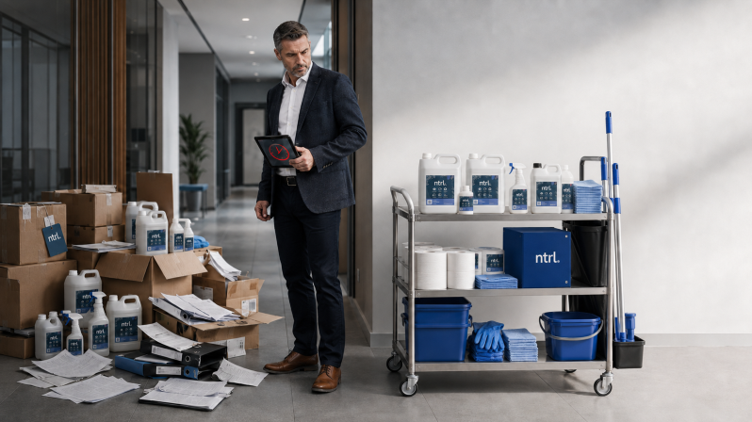
The cleaning itself is rarely the issue. The operatives know their sites, the schedules run, the floors get mopped. What breaks down is everything around the product: documentation that is not available when an auditor asks for it, pricing structures that obscure the real cost of use, suppliers who cannot support a sustainability tender, and stock that arrives late or gets substituted without notice.
These are supplier failures, not operational ones. And in 2026, they carry real consequences.
The stakes have shifted. Procurement teams are now evaluated on supplier readiness, not just unit cost. An unavailable Safety Data Sheet, an inconsistent dilution guide, or a supplier with no environmental accreditation can stall a contract renewal or fail a compliance audit before the quality of the cleaning is even considered.
According to ISSA, the worldwide cleaning industry association, the definition of a capable cleaning supplier has expanded significantly in recent years. Product performance remains the baseline. But documentation, traceability, continuity planning, and ESG credibility have moved from nice-to-have to procurement requirements.
This article sets out the four most common supplier failures affecting UK facilities teams right now, and what a genuinely capable supplier looks like in each area.
The Four Supplier Failures Costing Facilities Teams Most
Understanding where supplier relationships break down is the first step to fixing them. These four failures appear consistently across facilities procurement reviews in the UK.
1. Documentation That Is Not Ready When You Need It
Safety Data Sheets, COSHH assessments, product certifications, dilution instructions: these documents are not optional extras. Under HSE COSHH regulations, employers must be able to demonstrate that hazardous substances are properly managed. That requires current, product-specific documentation, not a generic supplier statement that "all products comply."
The problem is not that suppliers refuse to provide documentation. It is that they are slow, disorganised, or unable to provide records that match the exact product formulation being supplied. When an auditor arrives or a contract renewal requires evidence, "we'll send those over" is not an acceptable answer.
What good looks like: Safety Data Sheets available immediately, for every product, in the correct format. Certifications specific to the product and formulation ordered, not the product range in general.
2. Fragmented Supply Across Multiple Vendors
Many facilities teams end up managing four, five, or more cleaning supply relationships: one for chemicals, one for paper products, one for equipment, another for consumables. Each relationship carries its own ordering process, account terms, delivery schedule, and contact.
The operational cost of this fragmentation is rarely tracked but consistently significant. According to GEP's facilities management procurement analysis, fragmented supplier bases produce inconsistent service levels, zero comparability across sites, and no reliable view of total spend or performance. The result is structural value leakage: savings opportunities that decay as contracts roll over locally, and supplier leverage that weakens because volume stays split.
What good looks like: A single trade account covering chemicals, consumables, paper products, and equipment. One invoice, one delivery, one account contact who knows your sites.
3. Price-Only Thinking That Ignores Total Cost of Use
Unit price is the easiest number to compare. It is also one of the least useful metrics for evaluating cleaning supply value.
A concentrated product at a higher unit cost typically delivers a far lower cost per litre of working solution than a ready-to-use alternative at a lower list price. Add the packaging waste, storage space, and transport frequency of RTU products and the economics shift further. Facilities teams that buy on unit price alone routinely overspend on chemical costs by a significant margin.
The same logic applies to consumables. Cheap paper products with poor yield mean higher usage and more frequent ordering. Low-quality microfibre cloths that degrade after 50 washes cost more per clean than higher-grade alternatives that last 300 cycles.
What good looks like: A supplier who provides cost-in-use analysis as standard, showing the real cost per application or per clean, not just the list price per unit.
4. Sustainability Claims Without Evidence
ESG reporting requirements are tightening across the UK. Facilities teams tendering for contracts or reporting to parent organisations are increasingly required to evidence the environmental performance of their supply chain, not just assert it.
Many cleaning suppliers describe themselves as sustainable. Very few can provide independently verified accreditations, documented carbon management processes, or product-specific environmental certifications that will stand up to scrutiny in a tender or ESG audit. As the UK Cleaning Products Industry Association guidance makes clear, a generic commitment to sustainability is not a substitute for verified, product-specific evidence.
What good looks like: Third-party accreditations such as Neutral Carbon Zone (NCZ) Gold, EU Ecolabel certified product lines, and the ability to provide documented environmental evidence rather than marketing claims.
What a Capable Cleaning Supplier Actually Looks Like
Identifying the problem is straightforward. The harder question is what to look for when evaluating whether a supplier can genuinely meet the requirements of a modern facilities operation.
Use this checklist when reviewing your current supplier or assessing alternatives. Each item represents a reasonable procurement expectation, not an exceptional standard.
|
Requirement |
What to ask |
|---|---|
|
Documentation readiness |
Can you provide SDS for every product immediately, in the correct format? |
|
Product certification |
Do your eco products carry EU Ecolabel, Cradle to Cradle, or equivalent third-party certification? |
|
Cost-in-use analysis |
Can you show me the real cost per application for concentrates versus RTU alternatives? |
|
Environmental accreditation |
Do you hold an independently verified accreditation such as NCZ Gold or ISO 14001? |
|
Supply consolidation |
Can a single account cover chemicals, consumables, paper products, and equipment? |
|
Staff training support |
Do you provide access to accredited training programmes for cleaning operatives? |
|
Sustainability KPIs |
Can you provide annual sustainability performance data for inclusion in ESG reporting? |
A supplier who hesitates on any of these is telling you something important about how they will perform when an audit or tender deadline arrives.
The Training Gap Most Suppliers Ignore
One area where supplier capability is consistently underestimated is staff training. Product switches, new dilution systems, and microfibre adoption all require operatives to change their technique. Without proper training, the environmental and cost benefits of those changes are not realised.
Accredited training access, through programmes such as the Jangro Learning Management System, gives facilities teams a documented record of operative competency. That record is increasingly requested as supporting evidence in ESG audits and contract renewals. A supplier who can facilitate this is providing operational value well beyond the product itself.
Sustainability as a Procurement Requirement, Not a Preference
For facilities teams managing ESG commitments, the sustainability credentials of your cleaning supply chain are no longer background detail. They are foreground evidence. Surveyors, auditors, and contract managers are asking for documented proof, not assurances.
The practical implication is that supplier selection needs to include sustainability scrutiny alongside price and availability. Our sustainable cleaning procurement guide covers the specific certifications, product standards, and supplier questions that procurement teams should be using when specifying or renewing cleaning supply contracts.
How Janitorial Express Addresses the Supplier Gap
Janitorial Express has supplied professional cleaning chemicals, consumables, and equipment to facilities managers and cleaning contractors across Southeast UK since 1991. As a Neutral Carbon Zone Gold Accredited supplier and Jangro network member, the business is built around the requirements that modern procurement teams actually face.
That means:
-
Documentation on demand. Safety Data Sheets and product certifications are available immediately for every product in the range, via the Jangro SDS portal.
-
A consolidated supply account. One trade account covers the full range: cleaning chemicals, microfibre, paper products, waste management, PPE, and equipment. One invoice, one delivery relationship, one point of contact.
-
Cost-in-use analysis as standard. For trade account customers, the team provides cost-in-use comparisons for concentrate versus RTU products, so procurement decisions are based on real operational cost, not list price.
-
Verified sustainability credentials. NCZ Gold Accreditation, EU Ecolabel certified product lines, and documented environmental performance data for ESG reporting and tender submissions.
-
Accredited training access. Trade customers receive access to the Jangro Learning Management System, covering cleaning procedures, COSHH awareness, infection control, and environmental practice, with completion records for audit purposes.
For facilities teams reviewing their supply arrangements, or procurement leads preparing for a contract renewal, the starting point is a trade account conversation.
Request a trade account or quote from Janitorial Express to discuss your site requirements, consolidation options, and what documented supplier support looks like in practice.